|
| Rose-breasted grosbeak (Pheucticus ludovicianus) |
So we pick a date in May when some of the wintering birds might still be around, and when breeding birds have returned, and sporadic visitors are migrating through. This year, we set out on the afternoon on May 9 to the afternoon of the 10th. Within this 24 hours, four staff members found 135 species. Not a bad, as our total number has ranged between 125 and 142 in the past 20 years.
Getting out and searching for the birds awards us with great looks at many of the species, like this Baltimore oriole which was feeding on something in the seed clusters of a Box Elder tree.
 |
| Baltimore Oriole (Icterus galbula) |
Many migrating warblers are difficult to see. Sometimes we just hear their songs and know they are here, but it takes some work to see a 3 inch bird at the top of an oak tree with leaves. This year, Cape May warblers seemed to be plentiful, even hanging around long enough to get their pictures taken.
 |
| Cape May Warbler (Setophaga tigrina) |
This Northern parula is a breeding warbler species on the preserve and decided to catch a Mayfly and eat it in front of me.
 |
| Northern Parula (Setophaga Americana) |
Sitting still and listening to their songs and calls is the best way to observe bird diversity in your area. It never fails, when sitting still for a while, some birds will show up and put on a good show right in front of you like these cedar waxwings did along the Ohio river floodplain.
 |
| Cedar waxwing's (Bombycilla cedrorum) |
Just outside the preserves western boundary lays a grassy field that was loud with the songs of Dickcissel's. This spot produced other great grassland birds like grasshopper sparrows, bobolinks and blue grosbeaks.
 |
| Dickcissel (Spiza Americana) |
Luckily, this Yellow-billed cuckoo arrived the day we were counting birds. It was the first one we had heard or seen so far in 2018.
 |
| Yellow-billed cuckoo (Coccyzus americanus) |
A very loud migrant warbler called the Tennessee warbler is very easy to hear, but very hard to see. So we were lucky to have one low enough to photograph.
 |
| Tennessee warbler (Leiothlypis peregrina) |
Same thing goes with the hooded warbler seen below. I hear them all over the forests of the preserve, but to find one in the open is rare.
 |
| Hooded Warbler (Setophaga citrina) |
Of course, and easy way to find some of the birds is to simply watch feeders as we drive around the county. Although we had some fly-by Ruby-throated hummingbirds on our count, this male was easy to watch at one of our feeders.
 |
| Ruby-throated hummingbird (Archilochus colubris) |
Early in the morning, on ridge tops you will hear the song of the scarlet tanager. And if you have some patience, one will usually appear and sit still for good looks at its stunning scarlet feathers.
 |
| Scarlet tanager (Piranga olivacea) |
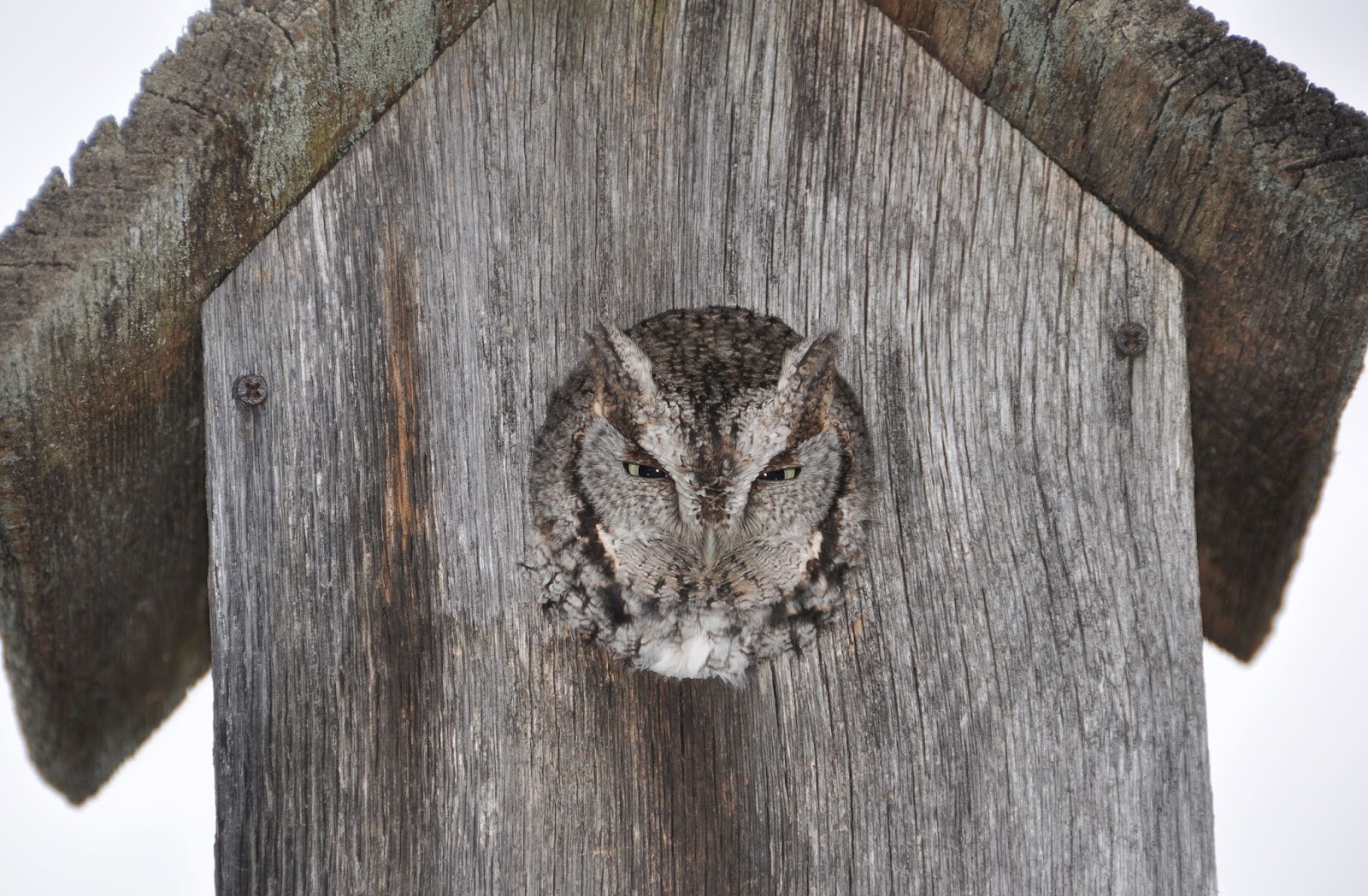
Of course we search into the night to find evening birds like Chuck-wills-widow's, woodcocks and owls. This Eastern screech owl almost landed on my head after whistling once imitating its call.
 |
| Eastern screech owl (Megascops asio) |
The majority of the preserve is forested, with bordering successional shrub-land and old fields. This habitat, along with the riparian forests of Ohio Brush Creek is a wonderful place to provide refuge for migrating bird stopovers, and suitable landscape for most of Ohio's breeding terrestrial birds.
The Edge of Appalachia Preserve System has been a birding destination for many years, and pride's itself as an important bird conservation area in Ohio.
Posted by: Mark Zloba