
Thursday, March 29, 2018
Spring 2018 Eulett After Hours Programs
Get ready for a brand new line-up of interesting and informative talks courtesy of our Eulett After Hours program! Check out the schedule and topics here!


Friday, March 23, 2018
Leafminers
I think many people believe that we already know what lives
on this planet, and there is not much more to discover. But there are still some curious explorers in
this country that are making new discoveries, more than one could imagine. Yes, we have names on many of the trees and
birds and mammals found around the world.
But many tiny creatures, some in your own backyards, are waiting to be
discovered. Two of these taxonomic
pioneers, Charley Eiseman and Julia Blyth, recently made a trip to the Edge of Appalachia to
teach a class on leafminers. Leafminers
are not people that dig in the earth to find leaves, but rather tiny insects
which, in the larval stage, mine (eat) through the fleshy inner cell layer of leaves. Just as Lewis and Clark traveled the country
keeping notes on new plants and animals they witnessed, Charley and Julia
travel across this country's backyards and forests to discover new insect tunnels on
leaves made by creatures still un-described in science.
 |
| Charley Eiseman showing the class an insect larva eating the inner portion of a leaf. |
Have you ever seen a leafminer? I bet you have. Look closely at leaves on almost any tree, and
you will probably find one. Although you
may not see the insect, the trail it leaves by tunneling through and eating the
innards is evidence of its existence. These tiny insects can be larval moths, flies, beetles or
even sawflies (wasp-like hymenopterans). They have utilized the niche of the tiny space within the mesophyll of
a leaf to eat, grow and presumably stay safe from predation. But as in all things in nature, nothing is
safe. Many predators have honed in on
these hiding insects and eat them. Parasitoids, many of which are wasps, can find and lay eggs on these
sitting ducks, by piercing the leaf with their ovipositors.
Charley and Julia have keen eyes and did not have to walk far from the building before finding leaves that bear the mark of a leafminer. They would find splotch mines or tunnel mines on grasses, tree leaves or any herbaceous plant. One species of beetle that feeds on Virginia Creeper, Parthenocissus quinquefolia, was new to science a few years back. This weevil is named Orchestomerus eisemani. Eisemani of course, from Eiseman because Charley discovered this new species. When they find a mine on a plant they have not seen before, they will take the plant home and wait for the critter creating the mine to pupate. At that point they can identify the adult and record the culprit.
Within two days of our class, Charley and Julia had collected,
identified and pressed the plants of over 100 specimens containing at least 80
species of leafminers. All of these
insects were new species additions for the Edge preserve collection. Charley is working on keys to identify the
leafminers. Knowing the shape and size
of the tunnel on specific plants can give you clues as to the species that
created it. So you may never see an
adult Agromyza ambrosivora fly, but
you can identify the mine on the leaf of an Ambrosia plant. These leaves have been mounted and housed in the Eulett Center herbarium for reference.
I think it is safe to say that you could count on one hand, if
there are any other naturalists in this country that could have identified this many
leafminers in such a short time. They are a great team and have shared with us a whole new world living inside a leaf. To see
more of their work, publications, and blog, and to get information on how to obtain
Charley’s new book, Leafminers of North America as well as his last
book Tracks and Sign of Insects and Other Invertebrates (co-written with
Noah Charney) click on the link here: http://charleyeiseman.com/leafminers/.
 |
| A tunnel mine of a moth, Phyllocnistis populiella. Notice the dark line of droppings left behind in the tunnel. |
 |
| A moth, Stigmella intermedia, on sumac, lays eggs on the leaf surface. After hatching, the larva starts eating and you can see the tunnel grow wider as the larva grows until exiting the tunnel after pupation. |
Enjoy this short video of a beetle larva feeding on the inner layer of an oak leaf.
Charley and Julia have keen eyes and did not have to walk far from the building before finding leaves that bear the mark of a leafminer. They would find splotch mines or tunnel mines on grasses, tree leaves or any herbaceous plant. One species of beetle that feeds on Virginia Creeper, Parthenocissus quinquefolia, was new to science a few years back. This weevil is named Orchestomerus eisemani. Eisemani of course, from Eiseman because Charley discovered this new species. When they find a mine on a plant they have not seen before, they will take the plant home and wait for the critter creating the mine to pupate. At that point they can identify the adult and record the culprit.
 |
| Charley Eiseman holding the leaf of Virginia Creeper with the mine of Orchestomerus eisemani |
 |
| Charley and Julia recording data of the mines collected during the class. |
 |
| A few of the mounted specimens kept for reference. |
Following are some examples of leafmines showcasing the artistic blotches and squiggly lines helpful for identification.
 |
| A moth, Astrotischeria astericola on aster |
 |
| A fly, Aulagromyza orbitalis on Orange-fruited horse gentian, Triosteum aurantiacum. |
 |
| A moth, Cameraria guttifinitella on Poison Ivy, Toxicodendron radicans. |
 |
| A moth, Coptotriche fuscomarginella on Black oak, Quercus velutina. |
 |
| A moth, Ectoedemia platanella on Sycamore, Platanus occidentalis. |
 |
| A fly, Liriomyza eupatoriella on white snakeroot, Ageratina altissima. |
 |
| A fly, Liriomyza sp. on Ironweed, Vernonia. |
 |
| A moth, Parectopa robiniella on black locust, Robinia pseudoacacia. |
 |
| A moth, Phyllocnistis vitifoliella on grape, Vitis sp. |
 |
| A moth, Stigmella prunifoliella on black cherry, Prunus serotina. |
Posted by: Mark Zloba
Wednesday, March 14, 2018
Who's watching you?
There is something to be said for being at the right place at the right time. If there is anyone around here that IS at the right place, it's usually Rich McCarty. While turning the truck around in a driveway in the middle of the preserve, Rich noticed something unusual. This particular driveway has 2 squirrel boxes on top of the posts holding up a gate.
As he pulled in, one squirrel box hole was black as usual, the other was not. After doing a double-take, he realized something was stuffed in the hole, blending in with the old barn wood front. It was just before dark, and this little critter must have been sticking its head out to see if the coast was clear to come out for the night.
What are the chances of pulling up to this gate and seeing an Eastern screech owl staring at you as if it wanted to ask a question??? Well, pretty good, as one week later he drove by again in the evening and it was peering out of the hole once more.
Eastern screech owls are cavity nesters, and will reside in bird/squirrel houses if the hole is big enough, abandoned buildings and holes in trees. It will be interesting to go back in late April, early May to see if this owl used it for egg laying and the fledglings are hanging around.

A good reminder to keep an eye on those holes out in nature, because you never know who or what's keeping an eye on you!!

Posted by: Mark Zloba via Rich McCarty
 |
| A quick cell phone picture before exiting the truck. |
 |
| Almost looks like this Eastern screech owl ate too many jumping mice last night and can't get out of the opening! |
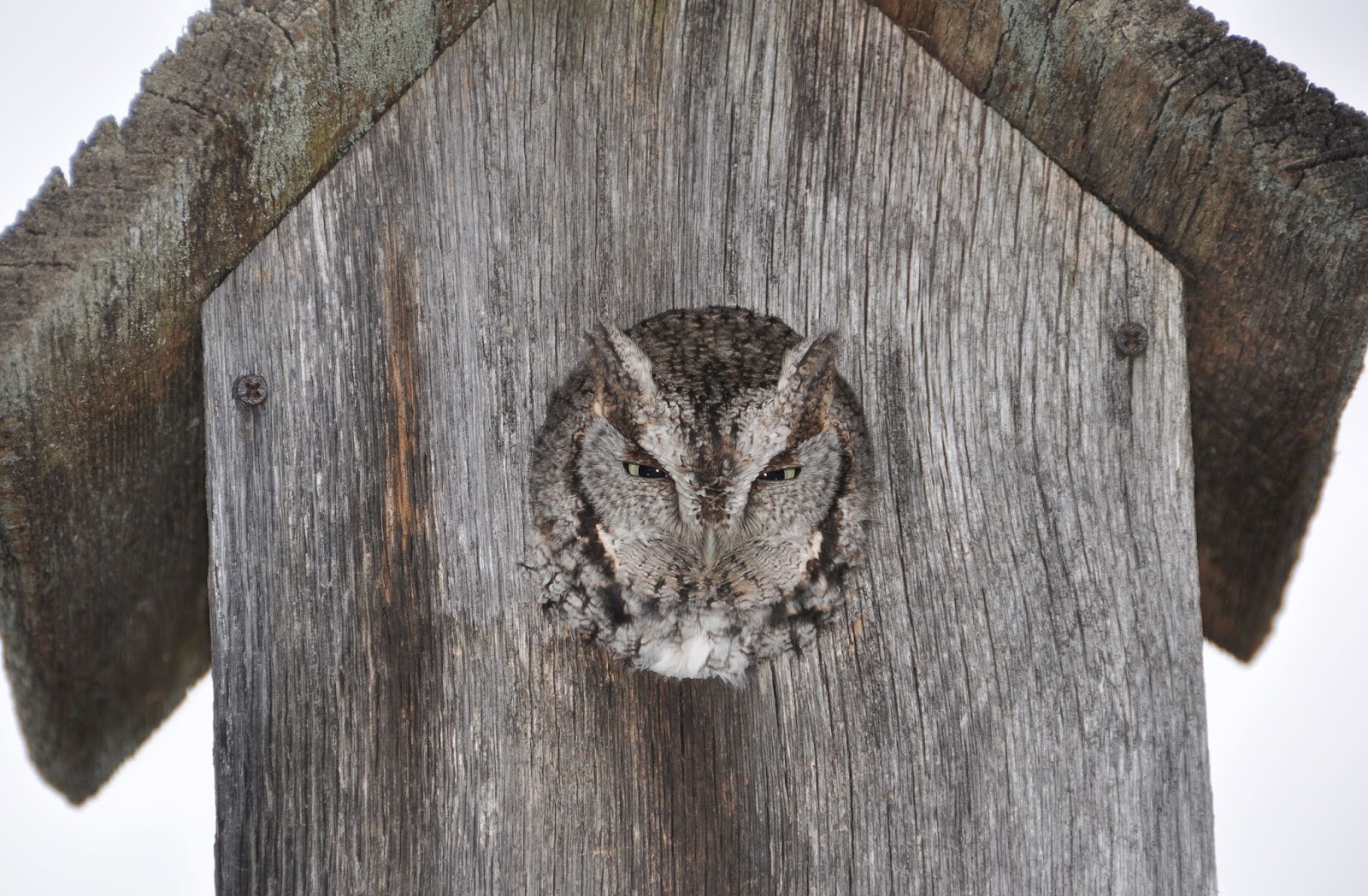 |
| It must have assumed it's camouflage was enough to escape detection, or was waiting to pass on some wisdom! |


Posted by: Mark Zloba via Rich McCarty
Friday, February 2, 2018
What's eating that deer?
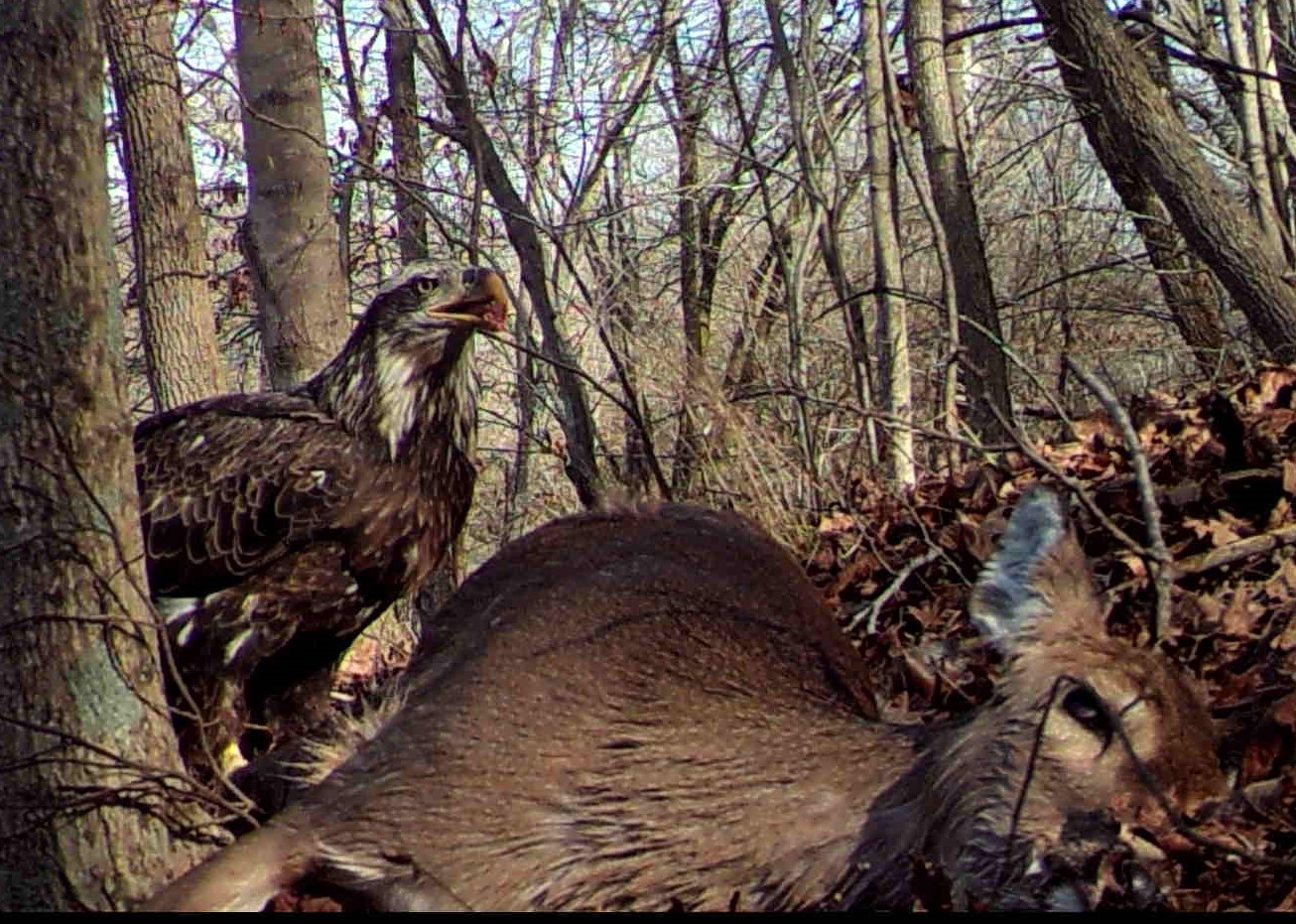
A bald eagle was spotted flying from the forest floor along Waggoner Riffle Rd. near the Edge of Appalachia Preserve headquarters. Rich McCarty was the spotter, and after further investigation he found a white-tailed deer carcass, which he assumed the eagle had been feeding upon. Rich showed me the deer and we wondered if the eagle really was feeding on it and what other animals would visit for a feast. So I decided to put a game camera near the deer which, triggered by motion, will take photos and video of anything moving in front of it. After leaving the camera out for 2 nights, it was fun to go through the hundreds of videos to see what appeared. Enjoy this short video of the culprits (you might want to finish eating first).
Five animals were large enough to trigger the camera in that 2 day period. They were: American crow, Red-tailed hawk, Coyote, red-shouldered hawk and a juvenile bald eagle. Doing what many animals do, they start feeding on the rear end of a carcass first. This must be where the best meat is... the rump. Here are some photos from the feeding event in the case your device won't play the above video.


Although unfortunate for the deer, a dead animal is an important part any ecosystem. Especially in winter when some predators may have more difficulties hunting food. An incredible amount of organisms will benefit from this one dead animal. A game camera will not display the myriad of insects, worms, fungus and even plants that will benefit from the decaying of this deer. But there are many. If you have a game camera, hold your nose and use it in this way to explore what is utilizing carcasses in your territory.
Posted by: Mark Zloba
 |
| Juvenile bald eagle showing its size and power tearing into the deer. |

 |
| Red-shouldered hawk flying in for a taste. |
 |
| Notice the size difference in the red-shouldered hawk on the deer and the bald eagle above. |
 |
| A red-tailed hawk joined in for a few videos one morning. |
 |
| Both days and nights a coyote (probably different individuals) made multiple appearances. |
 |
| Coyotes did the majority of tearing on the deer's rump. |
 |
| American crows also made numerous stops to have a meal. |
Posted by: Mark Zloba
Wednesday, January 24, 2018
Buzzardroost Rock Mural
 |
| Artist Suzanne Chouteau in front of completed mural. |
West Union, Ohio is home to a new mural depicting the preserve's iconic Buzzardroost Rock thanks to the Adams County Arts Council who received a grant from the Ohio Arts Council for painting murals in Adams County. The mural was based on a reduction woodcut by Xavier University Art Professor, Suzanne Chouteau who oversaw all the artistic aspects of the mural and was one of three people to paint the colossal 19 x 62 foot image.
 |
| The mural is dedicated to renowned ecologist E. Lucy Braun who was instrumental in having Buzzardroost protected. (E.Lucy Braun photo courtesy of University of Cincinnati Archives) |
 |
| The three artists at the start: Suzanne Chouteau, son Eli Bedel and husband Chris Bedel. |
Chris Bedel, Preserve Director for Cincinnati Museum Center at The Edge of Appalachia Preserve (and husband to the artist) painted and oversaw the technical aspects of the production like how to enlarge a 6 x 19 inch woodcut to building size and then how to get it on the wall. Eli Bedel, Xavier University DIFT major, and son to Suzanne and Chris, also braved shaky scaffolding and dizzying heights on the lift to assist with painting. ArtWorks of Cincinnati generously offered their advice on paint and other technical aspects.
 |
| Eli Bedel with mural background colors and terribly scary scaffolding used to paint parts of the mural. |
The under painting necessary to provide background colors to the final over lay of paint had the West Union town folks worried as to what exactly they were going to have to live with for the next 20 years or so! One person guessed it was a piano.
 |
| Suzanne Chouteau doing over painting that brings the mural to life. |
In complete disclosure, the author was a bit worried as to how it would turn out until the over painting revealed that the mural was going to be a stunning painting worthy of representing Buzzardroost Rock as it has never been seen before. As well, the mural has many moods depending on the time of day and light. The light before sunset makes the mural glow and the vivid colors become radiant, at times taking the author's breath away.
 |
| The other scary apparatus used to paint, a hydraulic lift generously donated for the painters' use by local contractor Doug Ruehl. |
While the picture makes the lift look harmless and safe enough, it took time getting used to being off the ground. As well, its occasional malfunction got the painters' attention and put hair on end when 25 feet in the air. It also provided a perch from which to see the hills of the preserve to the east and the many insects that frequented the wall's bright colors, like butterflies, flies and grasshoppers. Soaring vultures were also constant companions as if they wondered whether the three painted vultures on the mural were real.
 |
| Letters were hand stenciled using tape and free hand cut masks to block out letters for painting. Suzanne shown peeling tape off to expose finished letters. |
If someone would have told the author that painting murals was very difficult, he would have said "How hard can it be?" Let us count the ways: the solar radiation reflecting off a white wall in summer is beyond blinding. Not to mention feeling like walking "fried chicken" with temps at the wall 10-15 degrees hotter than the surrounding air. Thankfully some of the painting took place at night, late at night, there were countless nights where painting took place until 3 and 4AM! Did I mention the wind?
 |
| The mural half done showing the background colors that were painted first then the final detail overlaid in purple. |
 |
| Chris Bedel at the microphone for the dedication ceremony. |
All in all the mural was a great success. The building's owner, attorney and judge, Alan Foster is very pleased with the results as well as the town folks who came up on many occasions to express their gratitude. An unexpected result were the many hikers who had just come from hiking the trail to Buzzardroost Rock to stop for a picture with the mural. Maybe a new craze will ensue that will drive increased tourism? The mural is located across the street from the eastern side of the courthouse so stop and pay it a visit on your next visit to The Edge of Appalachia Preserve!
Proudly posted by: Chris Bedel, Preserve Director
Tuesday, January 23, 2018
Adams County Christmas Bird Count

With the coming of winter in Adams County, there are a few annual events you can rely on. Piercing cold temps, slick roads, wet boots, sore throats, taxes and my favorite, the Adams County Christmas Bird Count (CBC)
 |
| Cold day in Adams County, Ohio |
 |
| Typical view when driving around EOA searching for wintering birds |
 |
| Purple finch, a winter visiting species eating sunflower seeds from a very nice guy's feeder! |
 |
| CBC teams count all birds encountered, even if large flocks fly by like these Canada geese |
 |
| CBC is a nice way to get out and enjoy some of our more common resident birds like this Downy Woodpecker. |
 |
| Fox sparrow, another winter visitor is sometimes hard to find on the day of the count. 4 were found this year. |
 |
| Dark-eyed Junco, another winter visitor will frequent feeders if you have them |
| Here is the tally for all birds found on December 16, 2017. Snow Goose 1 |
| Canada Goose 837 |
| Wood Duck 9 |
| Gadwall 9 record high number |
| American Black Duck 66 |
| Mallard 616 record high number |
| Green-winged Teal 3 |
| Ring-necked Duck 3 |
| Lesser Scaup 285 record high number |
| Bufflehead 12 |
| Hooded Merganser 46 |
| Wild Turkey 18 |
| Pied-billed Grebe 1 |
| Great Blue Heron 8 |
| Black Vulture 173 |
| Turkey Vulture 15 |
| Northern Harrier 5 |
| Sharp-shinned Hawk 3 |
| Cooper's Hawk 5 |
| Bald Eagle 6 |
| Red-shouldered Hawk 6 |
| Red-tailed Hawk 47 |
| American Coot 1 |
| Sandhill Crane 3 Second time found during Adams Co. CBC |
| Killdeer 5 |
| Ring-billed Gull 2 |
| Rock Pigeon 274 |
| Mourning Dove 405 |
| Eastern Screech-Owl 10 |
| Great Horned Owl 5 |
| Barred Owl 5 |
| Belted Kingfisher 7 |
| Red-headed Woodpecker 7 |
| Red-bellied Woodpecker 50 |
| Yellow-bellied Sapsucker 3 |
| Downy Woodpecker 47 |
| Hairy Woodpecker 17 |
| Northern Flicker 19 |
| Pileated Woodpecker 16 |
| American Kestrel 65 |
| Eastern Phoebe 3 |
| Blue Jay 214 |
| American Crow 395 |
| Horned Lark 49 |
| Carolina Chickadee 95 |
| Tufted Titmouse 105 |
| Red-breasted Nuthatch 3 |
| White-breasted Nuthatch 87 |
| Brown Creeper 4 |
| Winter Wren 3 |
| Carolina Wren 41 |
| Golden-crowned Kinglet 18 |
| Ruby-crowned Kinglet 1 |
| Eastern Bluebird 224 |
| Hermit Thrush 1 |
| American Robin 976 |
| Brown Thrasher 3 |
| Northern Mockingbird 16 |
| European Starling 2998 |
| Cedar Waxwing 52 |
| Yellow-rumped Warbler 85 |
| American Tree Sparrow 36 |
| Field Sparrow 51 |
| Fox Sparrow 4 |
| Dark-eyed Junco (Slatecolored) 171 |
| White-crowned Sparrow 35 |
| White-throated Sparrow 92 |
| Song Sparrow 99 |
| Swamp Sparrow 5 |
| Eastern Towhee 9 |
| Northern Cardinal 248 |
| Red-winged Blackbird 20 |
| Eastern Meadowlark 39 |
| Common Grackle 49 |
| Brown-headed Cowbird 55 |
| House Finch 48 |
| Purple Finch 15 |
| American Goldfinch 136 |
| House Sparrow 134 |
| Total Individuals 9734 |
| Total Species Reported 79 |
 |
| Yellow-bellied sapsucker is the woodpecker that leaves lines of holes on trees. Photo by Robyn Wright-Strauss |
 |
| White-breasted nuthatch, a resident bird commonly hears in the forest sounding like a nasally Long Islander saying "Hank, Hank, Hank'. Photo by Robyn Wright-Strauss. |
Bald
eagles seem to be getting more and more frequent as we tied the record high
with 6. Along with brown thrashers which
also had a tie with the record high of 3.
The only record high numbers of individuals this year were Mallards at
616, Gadwall at 9 and 285 Lesser Scaup.
Many thanks to all who participate, and if you are looking for a fun adventure next winter, join your local CBC next year. Info can be found at www.christmasbirdcount.org
 |
| A very far away shot of a bald eagle. 6 were found on count day. |
Posted by: Mark Zloba
Subscribe to:
Posts (Atom)