Friday, February 26, 2016

Going to the pool in winter (Vernal Pool)

We've had some warm and rainy February days out here at the Edge of Appalachia Preserve, and that means its time to check the vernal pools and see what kind of amphibian activity has occurred.  Vernal pools are wet places that hold water in the winter and spring, but dry up in the summer and fall.  They can be ponds in a field, roadside ditches or any depression that holds a little bit of water half the year.  If a vernal pool has been established for many years, there's a good chance frogs, toads and salamanders have used it as breeding pools for egg laying.  They choose vernal pools because they hold water long enough for the presence of food sources  (i.e. insects, amphipods etc.), but not long enough for prey species to become established (i.e. fish).
 
This wet field in the winter is a great vernal pool for amphibian mating
I checked a couple pools on the preserve this week to see what has been moving.  There are a few salamander species that use these pools this early and couple of frogs as well.  Scooping a net in a pool produced a few inch-long salamander larva.  Any larva that large in a pool in February would have to be that of the marbled salamander, Ambystoma opacum.  And these were indeed marbled larva.  Marbled salamanders mate and lay their eggs in September within the pool boundaries when it's waterless.  Throughout winter, as the water fills the pool, the eggs hatch and the larva start growing before any other species lays eggs in the pool.  The adult pictured below was from the fall, only larva are found in the pool in February. 
 
Marbled salamander (Ambystoma opacum) from September.  Larva are now swimming in the vernal pools
Also within the pool were small clumps of gelatinous eggs holding Jefferson salamander, Ambystoma jeffersonianum, larva.  I did not find any adult Jefferson salamanders in the pool, but did find an adult under a rock at the edge of the pool.  Jefferson salamanders will move to the pools to mate at the first warm (>55F) rainy nights in the winter.  I have found eggs in pools as early as December 27th.  But February is the typical time for mass movements of these salamanders.  Years ago I was doing recruitment surveys for a state herpetologist. During this survey, I (with the help of Rich McCarty TNC) counted 270 Jefferson's, and that was only what was in the traps.  I can count the thumb on one hand, and that's the number of Jefferson salamanders I have seen in the wild that were NOT in or around a vernal pool.  So if you wanted to find one....now's the time.
 
Jefferson salamander (Ambystoma jeffersonianum) under rock at edge of pool
Also in February the spotted salamanders, Ambystoma maculatum, will be moving in mass to these same pools.  They are historically a little bit later than Jefferson's, but are due.  I just didn't see any this day.  All three of the salamanders mentioned above are often called mole salamanders because they spend most of their life underground.  This is why they are so hard to find, unless, you know about their breeding habits and when and where to look for the annual movements to vernal pool.
 
Spotted salamander (Ambystoma maculatum) found in previous years but not from this week. 
 
Ambystoma salamander eggs in a vernal pool.  Much smaller clump than the woodfrogs.  Clump on the left looks like it was laid much earlier than clump on the right.
I couldn't help but notice a huge mass of eggs at the end of one of the pools.  This is typical of the woodfrogs, Lithobates sylvaticus.  The weekend before, woodfrogs were calling  all over the county.  Unlike the salamanders, the early spring frogs give you a signal that the time is here.  And you can hear it from far away, leading you to these vernal pools.  In February, spring peepers, Pseudacris crucifer, and woodfrogs are the only species tolerant enough to withstand the cold temperatures before and after the egg-laying.  Both were heard calling throughout the day.  But only the woodfrog leaves the massive amounts of eggs like these shown below this time of year.
 
Although under water, you can still see large numbers of clumps of woodfrog eggs.  Each black dot is one egg.
 
Woodfrog (Lithobates sylvaticus) eggs sticking to a branch.
Many spring peepers were found in and around one of the vernal pools, but their eggs are harder to find.  They also don't have as short of a breeding period as the woodfrogs.  You can hear spring peepers calling well into April and maybe May.  Woodfrogs are true winter breeders.  They even are adapted to freeze solid and still survive.  Even if the vernal pool freezes again this year, many of the eggs are structured to survive.  The black side of each egg faces the sun to absorb heat and keep from freezing.
Spring peeper (Pseudacris crucifer) hiding in the grasses near the vernal pool.


Woodfrog (Lithobates sylvaticus)
To hear woodfrogs and spring peepers calling in one of our vernal pools, listen to the video below.  The spring peepers  are the high pitched whistles and the woodfrogs are the quacking chatters in the background.

Some of these species are very hard to find in the wild.  But if you learn the life histories of each species, you can definitely learn the tricks of where and when to look.  Finding the eggs in the pools and hearing the calls of the frogs, to me,  represent the first real signs that spring is right around the corner.  The amphibians' annual ritual of visiting these pools have created an annual ritualistic hunt for myself and many naturalist that brightens up the long gray winter.

For more information about these vernal pool species, check out Amphibians of Ohio, 2013 from Ohio Biological Survey’s website here.  This book contains an enormous amount of information about all of Ohio’s amphibians.
  
Posted by: Mark Zloba

Wednesday, February 10, 2016

Five minutes under a rock

Curiosity is a funny thing and I hope I never lose it.  While walking through a field, I stopped to photograph a lichen growing on exposed dolostone rock.  Although locally common, statewide it is a very uncommon lichen called Psora pseudorussellii.  Pictured below, it is a squamulose lichen attractively colored with red apothecia (red discs which are the fruiting bodies of the fungus).  


Psora pseudorussellii

After photographing the lichen, I noticed a smaller rock nearby, a little bigger than a football.  Like a dog to a fire hydrant, I am attracted to rocks I think I can lift.  I can't seem to shake the curious question of "what is under that, and every rock"?   And of course, there is always the chance of finding something I haven't seen before, so why not take a look.


The rock.  A piece of Peebles dolostone.
So I took about five minutes to quickly look and see what animals I could find (at least visible to the naked eye).  Almost immediately, two critters disappeared into the cracks of the ground before I could get a picture.  One was a common exotic earthworm called Lumbricus rubellus.  Everyone has seen this worm before, and it is not too hard to identify if you can recognize its faint red wine color.  The second was a sowbug or wood louse (sowbugs can't roll into a ball like pilbugs, Armadillidium sp., but look similar) called Trachelipus rathkei.  T. rathkei is a fast, 2-tailed sowbug and also an exotic species.  Both of these are expected under rocks at the "Edge".

But a few animals stuck around long enough to photograph, or proof of the animals existence was there.  A female wood roach, Parcoblatta sp., stood still long enough for a pic.  A few leafhoppers showed up after I lifted the rock.  These little hoppers from the genus Erythroneura jumped into the soil under the rock, but I think were in the grasses beside the rock and not underneath.  All pictured below.


  Parcoblatta sp. of wood roach commonly found under rocks and logs on the preserve.

Erythroneura sp. leafhopper showing very attractive pattern.  Many leafhoppers are just as showy as the prettiest butterflies.........in my opinion.


Another Erythroneura  leafhopper, barely a millimeter in size
What got my attention in those few minutes of looking under that rock were the amount of micro-snails (<5mm) and/or snail shells on the rock or in the dirt underneath.  I quickly counted the species I could identify, and collected a couple of shells I knew would require a scope for identification.


If you look closely you might find snail shells under the rock
Most shells will blend in well with the soil or rock, so you need to search carefully.  Here a Catinella vermeta blends in.
Many small land snails can be found under rocks and woody debris on the ground as well as grass thatch where it meets the soil.  This particular rock had 14 individual snail shells found within this short search time.  None of them larger than 4 millimeters.  Luckily, land snails are easily identifiable by using their shell, so if the animal is dead, you can still identify it to species.  They were: the white-lipped dagger, Pupoides albilabris, 2, the armed snaggletooth, Gastrocopta armifera, 4, the minute gem, Hawaiia miniscula, 3, the suboval ambersnail, Catinella vermeta, 2, the wild hive, Euconulus chersinus, 2 and 1 small unknown Gastrocopta.  


2 snail shells.  The one on the right shows the "teeth" of the shell opening giving reason to the common name armed snaggletooth snail.
Armed snaggletooth, Gastrocopta armifera shell
 I wanted to take a closer look at the small unknown Gastrocopta. I was hoping it was the rare species Gastrocopta rogersensis, which was newly described in 2001 in Iowa, only to be found a couple years later here at the Edge by one of it's author's Jeff Nekola.  The range of this species is hundreds of miles west of the Edge, making his find a disjunct anomaly like so many other species found on this preserve.  Since his discovery of this overlooked land snail, I have found them in 2 other prairies on the preserve.  But it would be nice to extend its range within the preserve.

White-lipped dagger, Pupoides albilabris shell hiding in the mud.
Once back in the lab, and the few collected snails were placed "mouth up" under the dissecting scope, I could easily see "tooth" features in the opening of the shells.  My curiosity driving me to wonder what was under that rock has led me to an exciting find (at least to a small circle of maloco-phile folks).  I believe the mystery snail is Roger's snaggletooth (Gastrocopta rogersensis), the newly described species mentioned above.  This adds a fourth location of this snail on the preserve.


Here you can see the size difference in three of the shells. Gastrocopta rogersensis (>2mm), Hawaiia miniscula (2mm) and Pupoides albilabris (4mm).  So 4mm is a big snail under this rock.
These were just the larger animals I could see in a five minutes.  Just imagine how many creatures there really are if you could count the micro inhabitants under this rock.  I need to remember this when I am out looking under rocks and logs.  I should be a little more deliberate when putting a rock back in its place.  And maybe, hiding under the next piece of debris, an un-described species will be found, unknowingly waiting to be discovered.  Just curious.

Posted by:  Mark Zloba


Friday, January 22, 2016

Where does an Eastern box turtle go in the winter?


Two years ago, I decided to put radio transmitters on Eastern box turtles to track their movements, and use this as an educational tool with our Science Camps.  These transmitters were leftover from a previous project and had very little battery life left in them.  So instead of throwing them away, I thought it would be a fun way to learn a little bit about box turtle home ranges.  The students use a Yagi antenna and go in search of the turtle, and if found we would weigh it, record its sex and GPS where it was found.  Following individual box turtles has been interesting to say the least.  Sometimes they would not move for over a week, then all of a sudden travel a few hundred yards in a couple days.  Most days we would find the turtle we were after, some days it would be hidden so well that a half a dozen of us could not find it, even though the receiver attached to the antenna was beeping loudly (which meant we were close).

Student using antenna to track box turtles

In the winter of 2014-2015, I was lucky enough to find a turtle (EOA-2 it was labeled, but I call him Hoffa since he is hard to find) buried in the soil in its hibernation spot.  This was great because I had never seen where a turtle chose to spend the winter.  Nor did I know how deep into the ground it would go.  I was surprised to see that not all of the shell is under soil.  It must be deep enough to stay a constant temperature, warm enough to prevent freezing.  It was burrowed in a depressed part of the ground where a tree root had rotted.  The top of its shell was exposed and only leaf litter covered that part.  I don't know how it managed to cover itself with leaves like a blanket.  I guess it was that year's leaf fall from the trees. 
EOA-2 or "Hoffa" getting a new transmitter attached and weighing in at 442 grams
 In April of 2015 Hoffa (EOA-2) came out of his hole in the ground and moved about again.  Throughout the summer, Science Camp students tracked him again, giving us an idea of his home range.   One day, they went in search of Hoffa but they could not hear his "beep".  Each turtle has a frequency number associated with its transmitter that will beep when its number is plugged into the receiver.  And if it gets too far away, over a big hill or the battery dies, you will not hear a beep.  After weeks of searching and listening for the beep, we figured our time with Hoffa was over.  The battery must have died and I figured one day we will stumble upon him and take off the dead receiver.  Months went by and this did not happen.  So goes nature.
 
Some points where EOA-2 traveled in 2 years. Green tacks show where turtle was found.  Range measures 1500 ft. X 500 ft.
A few weeks ago, In December, I was thinking about Hoffa, and where he would hibernate this winter.  Some reptiles, like many snakes, hibernate in the same place each year, could Hoffa do the same?  How specific are box turtles to their winter burrows?  When I got to work, I went to the area he was hibernating in last winter. I re-found a tree that I thought he was near last year, and it had a depressed area where a tree root had rotted.  This was the same area as before.  I raked away some leaves and unbelievably, there was about 2 inches of a turtles shell showing through the soil.  I couldn't believe it, but there was a turtle, in the exact same spot as last year.  I dug a little bit of soil out to see if there was a transmitter, and it was there, still attached.  It was Hoffa.
"Hoffa" buried in the same location as last winter
Now, this may or may not be common knowledge to Herpetologists, but I did not know a turtle would return to the same location each year to hibernate.  At least this turtle did, 2 years in a row.  This March I will put a new transmitter on Hoffa, and hopefully we will get to track him for a third year, and just maybe, he will go back to this same root hole to hibernate.

Posted by: Mark Zloba


Thursday, January 7, 2016

Spiny oak slug caterpillar video

 
Sometimes we find things that just don't look like the books tell us they should.  This caterpillar is usually not this color, and usually not found on lichens on a black walnut tree.  But there it was one September day.
  If you feel like sitting back and enjoying life at a caterpillar's pace you might enjoy this video of the spiny oak slug.
 

Posted by: Mark Zloba

Wednesday, December 30, 2015

Bringing The Best to The Edge

With the start of 2016 just days away it seems appropriate to take a minute to reflect on 2015. One of the highlights of this past season was having world class researchers visit the preserve to instruct the museum's Advanced Naturalist Workshop Series #11. Bringing the best teachers to The Edge has been a yearly affair now for 11 years and we're very proud and thankful to be able to bring this caliber of education to southern Ohio.  Here was the lineup with some pics and a bit of info:

April 24-26, 2015
Crustose Lichens
Dr. James Lendemer, Post-Doctoral Researcher, New York Botanical Garden

Dr. Lendemer is one of but a handful of professional lichenologists working in the United States. His voluminous knowledge of all things lichen is awe inspiring and humbling. His casual demeanor belies his world authority status and his ocean-deep knowledge of lichens. After spending the weekend with James I can only say that he is pure genius. He had an eager audience for the workshop with everyone-who-is-anyone doing work on lichens in Ohio attending the workshop. Ray Showman, co-author of The Macrolichens of Ohio attended along with founding members of The Ohio Moss & Lichen Association, folks from the USDA Forest Service and beyond. A great group that managed to produce the most inclusive voucher collection of crustose lichens for the preserve to date. A few interesting highlight species found were Xyleborus sporodochifer which was recently described from The Ozarks and the Dolly Parton lichen  Japewiella dollypartoniana. Recently named by Dr. Lendemer to honor Dolly Parton's work to conserve the Appalachians.

Dr. Lendemer (right) viewing crustose lichens on a tree


Dr. Lendemer (left) with students looking for Zyleborus sporodochifer.


Saturday, June 20, 2015
Ohio’s Rubus
Dr. Mark Widrlechner, Iowa State University

Mark Widrlechner is the undisputed King of Rubus. He is one of the few people in the United States considered an expert in this difficult genus. For those unaware, the Rubus genus includes the blackberries, raspberries and dewberries, to name a few. It is a difficult group to identify specimens to species with much work still to be done with genetics and subsequent taxonomy. Dr. Widrlechner took us through the finer points of identifying this group and the participants prepared voucher specimens that are now housed in the museum's herbarium at The Edge.


A specimen produced at the workshop and now in the preserve's herbarium.


June 26-28, 2015
Bobcats & The Art of Remote Monitoring
Dr. Suzie Prange, Wildlife Research Biologist, ODNR Division of Wildlife
Tim Prange, Environmental Educator, Rural Action
Eric Householder, Wildlife Technician, USDA, APHIS Wildlife Services
Laura & David Hughes, avid remote monitoring practitioners

This workshop marked the first attempt to document the presence of bobcats on the preserve with remote cameras. The instructor team was a powerhouse of the best in their fields at working with these elusive cats. The team was led by Dr. Susie Prange who has been doing groundbreaking work on bobcats in Ohio. The team's efforts paid off with simply amazing videos of bobcats that were captured not a hundred yards from our education center. Several videos were taken at sites frequented by endangered Allegheny woodrats begging the question whether or not bobcats are actively hunting these rare rodents? A special thanks goes out to Laura and David Hughes who not only taught at the workshop but set many of the camera traps that captured the most amazing bobcat footage. Their innate sense of where animals frequent coupled with their penchant for detail and artistic flair made all the difference in the film that was captured. A sample of what they can do:


Video from Laura & David Hughes


July 24-26, 2015
Bumble Bees & Pollination Ecology
Mike Arduser, Retired Biologist, Missouri Department of Conservation

Five species of living bumble bee were identified during the workshop with the balance of Ohio bumble bee species identified through collections brought by Mike Arduser. Mike is a recently retired conservation biologist with a deep background in bee work. His bee work with The Nature Conservancy and other organizations is well respected. Would you like to learn more from this incredible instructor? Don't miss the Bees of the Midwest identification workshop taught by Mike Arduser at The Edge March 14-18,2016. Here's the link to register.

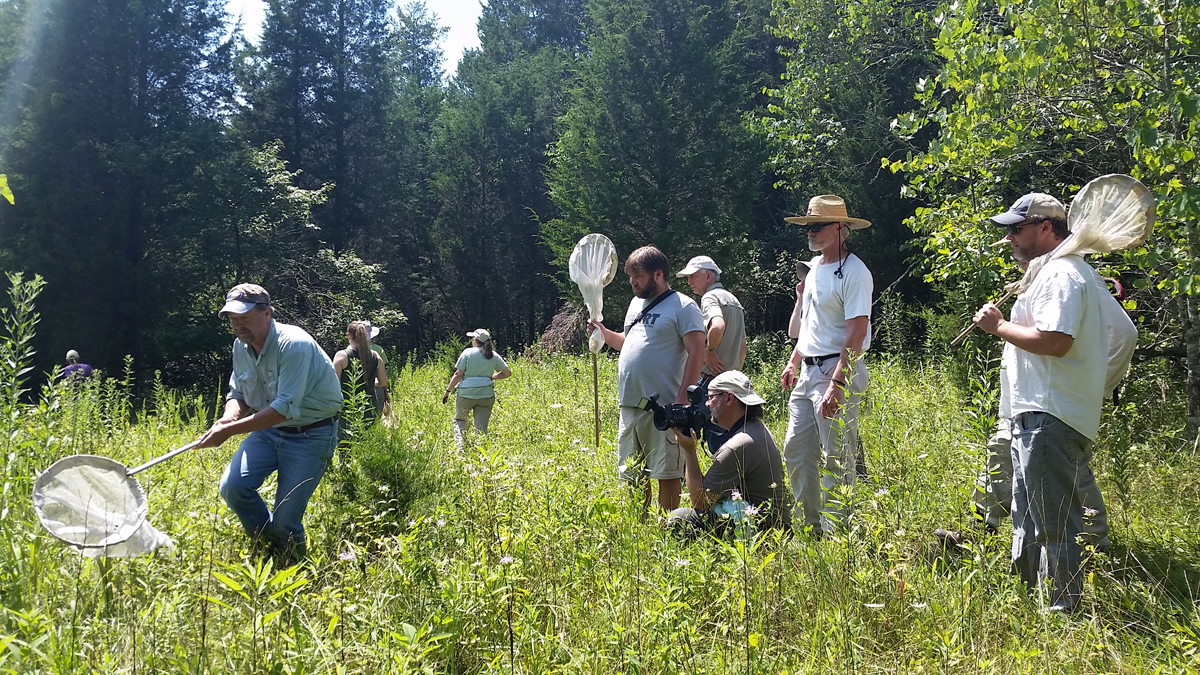
Mike Arduser (left) catching bumble bees with net in Lynx Prairie

Male Bombus impatiens with swamp milkweed pollinia (orange) attached to its feet.

September 18-20, 2015
Stoneflies
Dr. R. Edward Dewalt, Aquatic Entomologist, Illinois Natural History Survey
Dr. Scott A. Grubbs, Associate Professor, Western Kentucky University

Two of the greatest minds working on Plecoptera visited The Edge this summer to offer the most comprehensive stonefly identification workshop ever to be held in Ohio. Dr. Grubbs and DeWalt are leading scientists in researching stonefly distribution, both past and present, and what impacts global warming may have on these cold water loving specialists. Participants identified stonefly specimens from around the country that Ed and Scott brought along and some participants brought their own material to resolve long-nagging difficult identifications. Many stream biologists attended, including folks from the U.S. and Ohio EPAs, OSU and others to take part is this special training session.
Dr. Scott Grubbs teaching at the screen with Dr. Ed DeWalt co-instructing from the chair.


October 9-11, 2015
Land Snails
Dan Dourson, Senior Wildlife Biologist, Copperhead Consulting

Dan and Judy Dourson would certainly win the Friends of Mollusks Lifetime Achievement Award if there were such an award. Their dedication to land snail and slug conservation is laudatory and their efforts to teach others how to identify these animals is without bounds. We were fortunate to have them visit the preserve this past fall with 10 lucky workshop participants. See Mark Zloba's post on slugs for Dan's contact and to purchase his fantastic books on land snail identification/ecology of surrounding states that are very applicable to Ohio.


Adult land snails on a penny for size reference.

Dan Dourson teaching the finer points of slug identification..


Posted by; Chris Bedel

Tuesday, December 29, 2015

Do the "rat" thing

18 years ago when I first got to the Edge of Appalachia Preserve (EOA), there were 2 animals that symbolized the uniqueness and rarity of this landscape.  One was the green salamander and the other was a rat.  Rats are not usually the kind of animal you would get excited about, but this rat, the Allegheny woodrat (Neotoma magister), is a special animal.  At that time, Chris Bedel, the Preserve Director for Cincinnati Museum Center wanted to get the word out about these state endangered rodents.  He was even giving t-shirts with a rat on it to all children visiting the preserve and coined the phrase "Do the Rat Thing".  It turns out that even though historically Allegheny woodrats lived in a possible 8 counties (according to  A Guide to the Mammals of Ohio by Jack L. Gottschang), presently they are only found in southern Adams County, many of these sites on the Edge of Appalachia Preserve.

The state of Ohio is currently doing survey work by visiting historic locations to mark the absence/presence of rats, and collecting raccoon scat to look for the absence/presence of raccoon roundworm that is known to kill the rats.  Woodrats inhabit cliffs with many cracks and broken rock, and/or abandoned buildings left in the forest as home sites.  They do not prefer to live near people, so if you see rats around you house or farm, they are not Allegheny woodrats, but rather the Norway rat.  A non-native species. 
Allegheny woodrat habitat
In order to survey an area that might contain woodrats,  you look for at least one of three things.  A rat, a midden or a latrine.  A latrine is where it relieves itself of excrement, yep, it usually goes to the bathroom in the same place.  A midden is where it stores food, sticks, leaves or basically any junk it wants.  Allegheny woodrats are pack rats.  They love to collect things, and throughout the night, they run around picking up something it wants until it finds something else it wants better.  If you drop a nickel in woodrat country, it will be gone the next day and probably put in the woodrats midden. 

Midden of Allegheny woodrat at new location.
Latrine of Allegheny woodrat at new location.  Yes, that is a large pile of scat.
This makes for an interesting walk in the woods when you come across an old out building or cliff crack and see a pile of junk stuffed into one place.  You know some rat has been there actively collecting things for whatever reason.  I have seen middens with candy wrappers, shot gun shells, nuts, husks, glass pieces, flashlights (left behind from our students and pirated by rats), belt pieces, rubber pieces all collected simply because the rat liked it and couldn't help itself.  Pretty endearing I should say.  This is where the raccoon scat comes into play because if a rat picks up some raccoon scat that contains eggs of the deadly roundworm, and takes it back to the midden, it not only contaminates the midden with an organism capable of killing the rat, but any other rat that visits that midden for possibly the next 7 years.

So to help with the states efforts, we have been mapping out old sites and most importantly looking for new sites of this elusive animal.  Since most of it's home range left in Ohio is on EOA property, we inherit responsibility to know the locations of these rats and how active they are.  On the same trip as an early post about searching for green salamanders, I found 2 latrines and a large midden full of sticks and leaves in a location not known for woodrats.  Some of the leaves were green, so I knew there was an active rat using this location, which looked like the perfect habitat for woodrats.  Since we hardly ever see the rat in person, I thought the best way to know if one was there was to set up a game camera on one of the latrines and the midden.  I left the camera out for 1 week, and after collecting the SD cards, I soon found that there was definitely a rat living there.  See the videos below to watch this cute, yes, I am saying cute rat curiously moving about the cliffs of the preserve.


Both videos above are from the new location.  One is a rat at the latrine playing with some debris and the other is a rat trying to free a belt I stuck under a rock near it's midden.

Just like the green salamanders, I am sure we will find more locations of the Allegheny woodrat within the preserve.  But for the species sake, I hope the state finds them outside this county.  Hopefully in the next year or so, some genetics work will take place to learn the health of the Ohio populations and compare them to other states, where unfortunately they appear to be declining as well.  According to the biologists surveying the woodrat, this species seems to be disappearing across most of it's range in North America, and every little thing we can do to help might make a difference for its survival.  Protecting this large forested area of southern Adams County seems to be a good start.

Posted by: Mark Zloba


Friday, December 18, 2015

Slug Life

In our search to learn all the living things on the preserve, we invite many experts that can identify the critters that most people don’t take time to look at.  This fall, Dan Dourson and his wife Judy graced this preserve with their enthusiasm about all things natural, and in particular, came to teach about land mollusks.  Now, we already had a nice collection of land snails from the preserve.  67 species of land snail have been identified on the preserve before the Dourson’s arrival. But after the class a couple species were added and a couple were eliminated from our list.  And they helped clear up some confusing species.  For example, we commonly find a  snail called the upland pillsnail, Euchemotrema fraternum,  but I had no idea there was also a lowland pillsnail, Euchemotrema leai.  Well there is a lot of them around, and there is a very subtle difference between the two.  Apparently I have been collecting lowland pillsnails for years and never knew the difference, which is a small hole under the “lip” of the snail at the umbilicus.  If this sounds confusing or foreign, see picture below or use Dan’s books clear all this up.
Notice the hole in the center of the snail under the lip of the lowland pillsnail on the left.  No hole on the upland pillsnail on the right.
 
But land snails aren’t the only land mollusk to be found.  We have been overlooking slugs, which can be found about anywhere on the preserve,  for as long as we have been identifying everything else.  So now, with the Dourson’s help, slugs shall not be overlooked from here on in.


One reason slugs are overlooked is because of the lack of resources available for identification.  And with what is available, slugs still are not an easy subject.  But lucky for us, Dan has written a few books that can be helpful to Ohio naturalists.  Kentucky’s Land Snails and Their Ecological Communities, Land Snails of West Virginia and Land Snails of the Great Smoky Mountains National Park and Southern Appalachians.  These books have most if not all of the snails and slugs that can be found in Ohio, especially southern Ohio.


So I wanted to try to use Dan’s Kentucky book to identify slugs that I come across.  That’s when this little creature appeared, on lettuce brought from the preserve Director’s garden.  Luckily, before   accidentally eating it, it made its way into the lab for further study.  From Dan’s book I learned that if a slug has a “saddle” on its back, it’s probably a non-native slug from Europe.  Apparently, most of the slugs we come across, especially in yards and gardens are exotic species.  This little slug had a saddle, but I found that there is one species of native slug possessing a saddle.  Unfortunately, it is virtually identical to a non-native relative.  Only dissection can determine the correct identification.  But since this slug was in a garden, near a dwelling with many exotic plants and soil brought in for gardening, it is most likely the non-native Deroceras panormitanum, the longneck field slug.  Under a dissecting scope with good light you could really see the markings and patterns of this creature.  With this view, the patterns matched up with the Deroceras species, and the size of the animal along with the position of the saddle helped separate it from other genera.


Deroceras panormitanum, the longneck fieldslug.  Notice the "saddle" on its back.

  I wanted to photograph this 22mm slug to send pictures to Dan.  I set up a piece of lichen covered bark to stage the slug about 2 feet off a table.  Watching this animal move is interesting to say the least.  The slime trail it leaves can actually be used to identify slugs, but mostly the color of its defense slime is used.  They use the slime for locomotion, defense and for antibacterial properties.  I assumed the slug would be stuck on this piece of bark for a while, seeing how slugs do not move too quickly, and it was high off the table.  But by the time I got the camera set up the slug was gone and on the table.   I was amazed to see how this slug made its getaway.  It did not crawl off the bark at all.....but it slime rappelled.  I had no idea a slug would use its slime to lower itself, like a spider on a web, to escape an uncomfortable situation. 

I put the slug on the bark a few more times, and every time I did, it tried escaping the same way.  Why waste time crawling when you can rappel to get away.  I’d never have guessed that picking up this one slug would be so educational. I guess that it produces the slime while it’s hanging in mid-air and slowly can lower itself to the bottom.  And if they can hang there for periods of time, I would imagine this could be a great retreat from predators.


Longneck fieldslug making its escape.


Slowly rappelling away.

Head first seems a bit dangerous, but that's a slug for you.

Arrived at the bottom, unfortunately for the slug it's a large table and could be re-captured.

Adding a few new species of land snail to our collection was what I was hoping for with the Dourson’s visit.  But now after collecting many different organisms over the years, I am most excited about having our first slug species added to the collection.  After all, they are everywhere.  I rarely lift a log in the woods without seeing a slug, why not know what species I am seeing.  A small start, but we now can say we definitely have at least these 4 species of slug:  Deroceras panormitanum  the longneck fieldslug, Arion subfuscus the dusky Arion, Megapallifera mutabilis the changeable mantleslug and Philomycus carolinianus the Carolina mantleslug.

If you would like to learn interesting facts about slugs like their practice of stabbing love darts into their partners while mating, their abilities to eat highly toxic mushrooms to beef up their defense mucous, slugs anti-bacterial properties that help humans or most importantly how to identify them and their snail cousins, check out Dan’s books mentioned and pictured above.   These books are not sold in stores or yet on a website.  To buy one you must reach out to him personally at theroguebiologist@gmail.com. 

Posted by: Mark Zloba